
NATIONWIDE POND MANAGEMENT & MAINTENANCE SERVICES
Large Pond Filtration
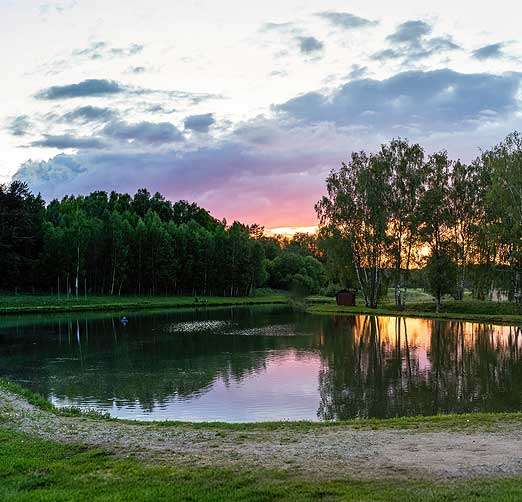
Large Pond Filtration
Wetlands are natural filtration systems that can convert nutrients found in lakes and flowing water into plants and aquatic organisms. Suspended solids like soil and expired plant particles are largely settled and retained. The challenge for pond owners is how to replicate this process with minimal construction cost and maintenance. Options include building an artificial wetland, mechanical filtration equipment or applying biological products. After having tried them all and engaging in years of research and product development we came up with a simpler more efficient system call the Country Pond Filter. First, lets explore the advantages and disadvantages of the forementioned systems.
Artificial Wetland Filtration:
Benefits:
- Water flow and retention time can be controlled
- Architecture and aesthetics can be combined for customer acceptance
- Diverse plantings support wildlife habitat
Drawbacks:
- May require considerable space
- Eventually matures requiring plant and media revitalization
- Channelization of water movement impedes efficiency
Mechanical Filtration:
Benefits:
- Scalable to meet the needs of the process
- Monitoring and measuring can be standardized
- Smaller footprint needed as compared to a wetland
Drawbacks:
- Works great until something breaks or goes off-line
- Cost of equipment and installation
- Requires scheduled service and training
Biological Product Application:
Benefits:
- Environmentally friendly
- Compliments existing microbial communities
- Supports the development of biofilms for nutrient absorption
Drawbacks:
- Sustainability dependent on water temperature
- Monthly applications may be needed to support culture growth
- Product cost
All of these systems have their advantages and disadvantages, there is not a “ silver bullet” for reducing excess nutrients that enter a pond. Sometimes the combination of systems is the best approach but may add a degree of complexity. Remember, simple systems are easier to fix when they break!
Our Story:
Duckweed was the target. We tried skimming the surface with long nets and college kid labor which made the ponds look good until the pizza and refreshments were consumed. Duckweed skimming is a great workout but not fun. Spraying high test vinegar turned duckweed temporarily brown and digested parts of our aluminum boat. Experimenting with biological bacteria cultures started us thinking about “competitive exclusion” for nutrients that support the continual growth of this fascinating miniature aquatic plant. Upon discovering an article published by a university research team investigating how algae could be processed into biofuel and used for cleaning water we changed our approach. After a proposal, a few stars aligned and a collective project was launched. Lab work with controlled conditions provided insight into the process of how unicellular algae cleaned pond water. Select strains of naturally occurring algae where cultured and applied to test ponds to determine biofilm formation and application rates. Five years of field work culminated with useful data collection and recirculating filter prototypes that could be placed on the ground adjacent to a pond and powered with electricity.
Results:
The results were mixed and intriguing. Failure or marginal success was attributed to water chemistry, filter material selection and site placement. When the filter system worked as hypothesized the results were amazing. Nutrient reduction was accomplished and pond owners with duckweed and algae problems were pleased.
One of the goals of this project was to construct a filter system that required minimal or no excavation work and could be shipped as a ready to install kit. After several modifications to lower the shipping cost we are offering a Country Pond Filter kit for ponds up to ¾ surface acres in size. For ponds 1 acre and larger we determined the most cost effective installation is to dig a basin 3-4 inches deep and use the excavated soil to berm up the side wall to create a filter depth of 6 inches. This technique provides a larger filter surface area and tends to be structurally stable. Directions, materials and consulting support are available for you or your contractor.